AI: The Source of Truth
Social media showed us that algorithms can influence what we see. Generative AI can influence how information is explained to us. What happens when an entire generation grows up treating AI not as a source of information, but as the source of truth?
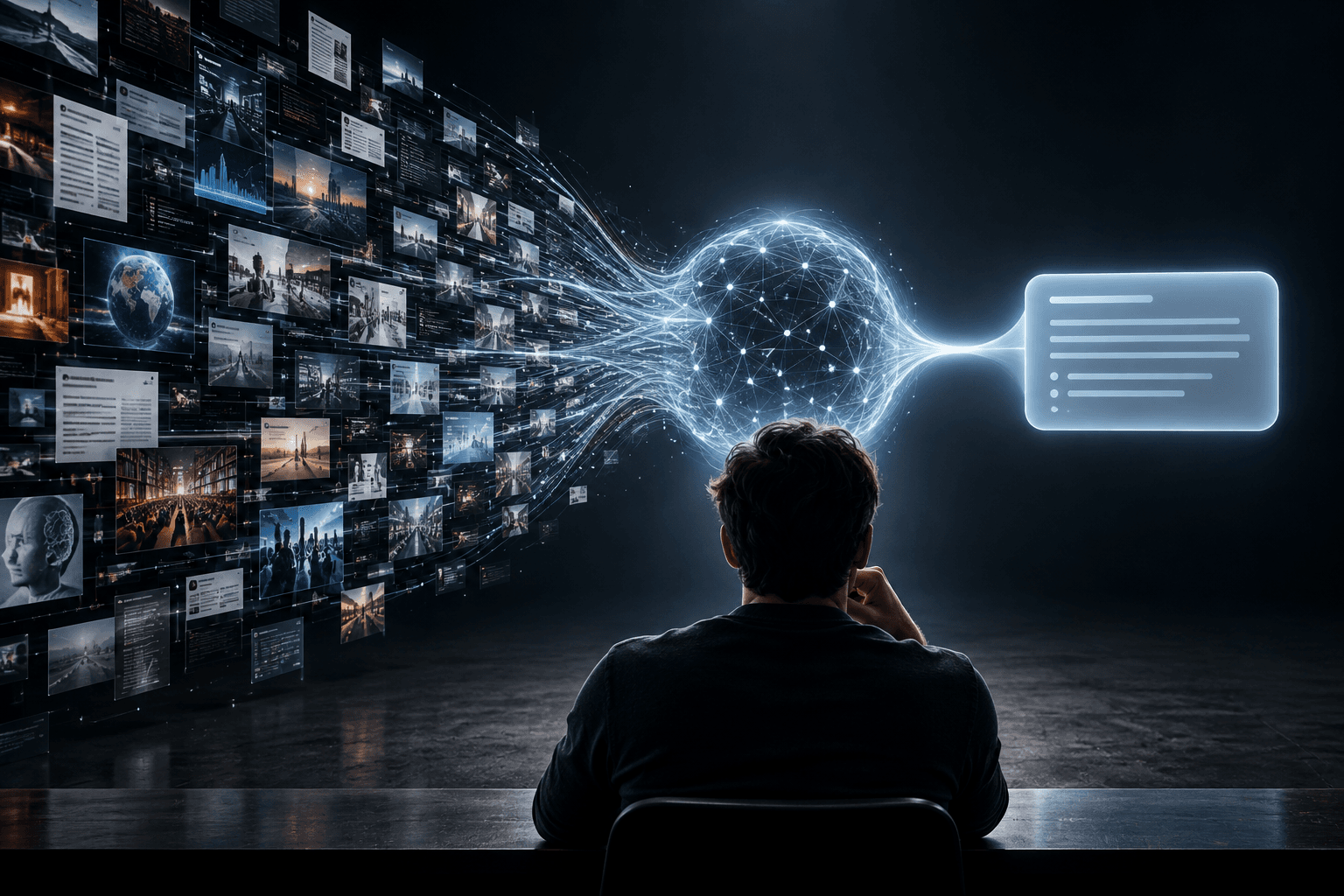
I use AI every day.
And when I say every day, I mean every day.
I use it for technology, research, troubleshooting, writing, projects around the house, learning something new, and sometimes simply to have a conversation about an idea I'm trying to work through.
I think generative AI is one of the most important technological advances I've witnessed in my lifetime.
And that's precisely why something about it is beginning to trouble me.
I grew up before Google, smartphones, social media and obviously ChatGPT. When I wanted to know something, sometimes I had to ask someone. Sometimes I had to find a book. Sometimes I had to try something, screw it up, and try again.
And sometimes I simply had to figure it out myself.
That experience taught my generation something almost accidentally:
The answer wasn't always immediately available.
And even when someone gave you an answer, you eventually learned that didn't necessarily make it true.
I'm beginning to wonder what happens to that mentality when an entire generation grows up with something radically different:
An intelligent system that's always available, seemingly knows almost everything, speaks with confidence, remembers context, can explain nearly anything at exactly the level you understand---and gets better every year.
What happens when AI stops being a source of information and becomes the source of truth?
We've Already Run the First Experiment
This concern didn't start with ChatGPT.
We've actually spent the last fifteen years conducting a massive real-world experiment on the relationship between algorithms and human behavior.
We called it social media.
Facebook, Twitter, YouTube, TikTok and other platforms learned that machine-learning models could become extraordinarily good at deciding what information to put in front of us.
What did you click? What did you ignore? What made you angry? What made you laugh? What did you share? Who did you follow? What kept you scrolling?
Those systems didn't need to understand the human mind perfectly. They needed to predict which piece of content would cause you to engage with the next piece of content.
And we have evidence that relatively simple algorithmically delivered interventions can influence behavior.
One of the most fascinating examples happened long before today's generative AI.
During the 2010 U.S. congressional election, researchers conducted a randomized experiment involving 61 million Facebook users. Different users received different voting-related messages. The researchers found measurable effects not only on political expression and information seeking, but on real-world voting behavior. The effects also spread through people's social networks.
Source: Nature --- A 61-million-person experiment in social influence and political mobilization
Think about the technology involved. This wasn't ChatGPT. It wasn't reasoning with anyone. It wasn't debating them. It wasn't listening to their objections. It wasn't constructing an argument specifically for that individual.
It was essentially changing what appeared on a screen.
And it still produced measurable effects in the real world.
From Choosing What You See to Creating What You Hear
Social media's power largely comes from selection. There are billions of possible pieces of information, and an algorithm determines which tiny subset appears in front of you.
Generative AI changes the relationship.
It doesn't just select information.
It generates an answer.
Ask a search engine a complicated political question and it gives you links. You still have work to do. You choose what to click, decide which sources you trust, and encounter conflicting opinions.
Ask an AI the same question and something very different happens.
It answers you.
Not with ten links. With an explanation.
If you don't understand, you ask another question. It explains it differently. If you disagree, you tell it why. It responds to your objection. If you provide more information about yourself or your reasoning, it can incorporate that information into the next response.
This isn't information retrieval anymore.
It's a relationship with information.
Persuasion at Scale
We're beginning to study this.
In 2025, researchers reported three preregistered experiments involving 4,829 participants examining whether LLM-generated messages could change people's opinions about public-policy issues.
They could.
The effects were relatively small---roughly 2 to 4 points on a 101-point policy-support scale---but they were consistent across several issues, including polarized ones. The researchers found that AI-generated messages were roughly as persuasive as messages written by ordinary people.
Source: Nature Communications --- LLM-generated messages can persuade humans on policy issues
Small effects shouldn't necessarily make us feel comfortable.
Because software scales.
Another experiment gets even closer to what concerns me. Researchers had people debate either another person or GPT-4. Some opponents were also provided basic personal information about the participant.
When GPT-4 could personalize its arguments using that information, it became significantly more persuasive. In debate pairs where one side was more persuasive than the other, personalized GPT-4 was the more persuasive participant 64.4% of the time. Without personalization, GPT-4 performed roughly on par with human opponents.
Source: Nature Human Behaviour --- On the conversational persuasiveness of GPT-4
The AI didn't merely generate an advertisement and show it to everyone.
It talked to an individual.
Social Media Was Version 1
Social media learned:
What should I show Dan?
Generative AI can potentially learn:
How should I explain this to Dan?
Those aren't the same thing.
A recommendation algorithm can discover that I'm more likely to watch one video than another. A conversational AI can hear my argument, understand why I disagree, formulate a response, hear my next objection and continue the conversation.
Experiments conducted around the 2024 U.S. presidential election and later elections in Canada and Poland randomly assigned people to converse with AI models advocating for candidates. Researchers found measurable changes in candidate preferences after those conversations, with effects larger than those typically found for conventional video political advertising.
Source: Nature --- Persuading voters using human--AI dialogues
That doesn't mean AI controls voters. It doesn't mean everyone can easily be persuaded. And it certainly doesn't mean today's AI companies or governments are secretly manipulating everyone's political beliefs.
That's not the point I'm making.
The important word is capability.
We now have evidence that conversational AI can influence people's opinions.
And we're at the very beginning of this technology.
Now Imagine Twenty Years
This is where I struggle with the implications.
AI arrived halfway through my life. I already had decades to develop opinions, skepticism, habits and ways of figuring things out before I ever had an AI sitting next to me.
A child born today will have a completely different experience.
AI could be there when they are five. It helps them understand dinosaurs. At eight, it helps with math. At twelve, homework. At sixteen, relationships. At eighteen, college.
Then their career. Their finances. Their health. Their marriage. Their children. Their problems.
Imagine interacting with an AI system thousands upon thousands of times throughout your development.
And imagine that it's right most of the time.
Trust isn't necessarily created because someone tells you trust this machine.
Trust develops because the machine earns it.
If I ask an AI 10,000 questions and it gives me useful answers 9,800 times, what happens when question 10,001 doesn't have an objectively correct answer?
Was this president good?
Why did this war really happen?
Is capitalism better than socialism?
What should governments be allowed to control?
What rights should individuals have?
Is this news organization telling the truth?
Which version of this historical event should I believe?
What should I believe?
These aren't Python questions.
There isn't always a correct output waiting at the end.
And yet the interface looks exactly the same.
You type the question.
AI answers.
Who Controls the Answer?
This is where the subject gets uncomfortable.
Governments around the world understand that AI will be strategically important. Companies understand it. Militaries understand it. Technology companies understand it.
There is an enormous race underway to build increasingly capable AI systems.
Most discussions about that race focus on compute, chips, models, economic productivity, military capabilities and eventually artificial general intelligence.
Those things matter.
But I wonder whether we're overlooking another extraordinarily valuable asset:
Trust.
If billions of people eventually ask a handful of AI systems to explain the world to them, then influencing those systems becomes incredibly valuable.
That doesn't require a conspiracy.
Models have training data. Someone selects that data.
Models are fine-tuned. Someone establishes those objectives.
Models have safety systems. Someone defines those policies.
Governments regulate technology. Companies operate it. Sources are selected and ranked. Some information is considered authoritative and some isn't.
These decisions have to be made. I'm not suggesting the people making them are doing something nefarious.
I'm asking something much simpler:
Who gets to make them?
And what happens when different governments, cultures and companies disagree about what the correct answer should be?
The Most Powerful Propaganda Machine May Not Look Like Propaganda
Traditional propaganda announces itself.
A government broadcasts a message. A campaign runs an advertisement. A corporation buys a commercial.
Someone is trying to convince you of something, and at least theoretically you recognize that persuasion is taking place.
Social media made that boundary fuzzier because algorithms decided what information received our attention.
Generative AI could blur it even further.
The most effective influence system imaginable might not tell you:
"Believe this."
It might simply be the system you've trusted since childhood answering:
"Here's what happened."
That's far more subtle.
And potentially far more powerful.
The Engineering Problem Nobody Talks About
I've spent much of my career working with complex technology systems.
There's an almost universal principle in engineering:
Don't blindly trust critical systems.
We monitor them. We log them. We test them. We build redundancy. We validate outputs. We maintain audit trails. We investigate anomalies. We want to know where data came from.
And when something is extremely important, we don't design an architecture where one opaque component becomes the unquestioned source of truth.
Yet we may be heading toward exactly that architecture for human knowledge.
That seems backwards to me.
Perhaps one of the most important challenges in AI isn't simply making models smarter.
Maybe it's making their answers more inspectable.
- Where did this information come from?
- Which parts are established facts?
- Which parts are interpretation?
- What credible sources disagree?
- What assumptions went into this answer?
- How confident should I be?
- Can I inspect the evidence myself?
Maybe the AI systems we should trust most won't be the ones that always sound certain.
Maybe they'll be the ones that make it easiest for us to challenge them.
I'm Not Afraid of AI
I want to be clear about that.
I'm incredibly optimistic about this technology.
I'll probably use AI more tomorrow than I do today.
I believe it will help us solve problems we haven't been able to solve before. I think it will change medicine, science, engineering, education and almost every industry.
I want to see how far it goes.
But enthusiasm for a technology shouldn't prevent us from thinking about what happens when that technology becomes enormously powerful.
Especially when the product isn't merely computing an answer.
The product may eventually become trust itself.
Those of us who grew up before AI remember having to figure things out.
Future generations may never know a world where the answer isn't immediately available.
Maybe our responsibility isn't to teach them not to use AI. That would be ridiculous.
Maybe it's to teach them something much harder:
How to use the most powerful source of information humanity has ever created without surrendering their responsibility to think.
Ask AI.
Learn from AI.
Debate AI.
Challenge AI.
Ask where its answer came from.
Ask for the strongest argument against what it just told you.
And sometimes recognize that there may not be one correct answer at all.
Because there's an enormous difference between AI becoming the world's greatest source of information...
...and AI becoming the world's unquestioned source of truth.