2026-05-24
Modern Cloud Architecture: A Game of Tradeoffs
How Kubernetes, cloud economics, disaster recovery, data sovereignty, and managed platforms turn modern infrastructure into a business strategy conversation.
Modern cloud architecture is not one decision. It is a chain reaction.
You start with containers. Then Kubernetes. Then autoscaling, ingress, GPUs, disaster recovery, cost controls, and governance. Then someone asks whether your data is legally allowed to leave a region.
That is when the conversation changes. It stops being about infrastructure and becomes a game of tradeoffs.
We Came for Containers and Stayed for the Compliance Audits
It usually begins with a sentence that sounds small and reasonable:
"We will just run it in Kubernetes."
That one decision quietly expands into an ecosystem of operational responsibilities that few teams fully anticipate. Months later, someone asks a deceptively simple question during a disaster recovery review:
"Can this application survive a regional outage?"
Suddenly the conversation is no longer about Kubernetes. It becomes about data replication, DNS failover, identity systems, compliance boundaries, GPU topology, storage consistency, legal data residency, observability, security policy, vendor lock-in, and cloud economics.
That is when many teams realize they are not just deploying applications anymore. They are operating a distributed cloud platform.
The Architecture Beneath the Architecture
The biggest misconception in cloud architecture is that each technology exists independently. It does not. Every layer influences every other layer.
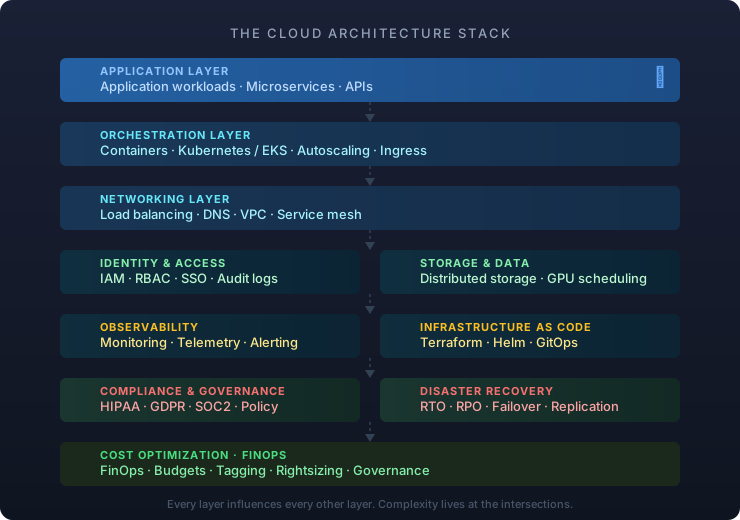
Individually, each component feels manageable. The real complexity lives at the intersections. A load balancer is not just a load balancer when it governs failover behavior. A database is not just a database when it sets your recovery point objective. A GPU node group is not just compute when placement and availability zones affect latency and application behavior.
The architecture beneath the architecture is the web of tradeoffs connecting all these layers together.
Kubernetes Was Never the Hard Part
Kubernetes gets blamed for complexity, but it is rarely the actual problem. What Kubernetes does is expose organizations to the realities of distributed systems design — and those realities were always there.
Once workloads are distributed, teams must reason about failure domains, state management, latency boundaries, regional dependencies, scaling economics, and operational ownership. Pod anti-affinity, topology spread constraints, multi-AZ node groups, cross-region replication, placement groups — each pattern addresses a real failure mode, and each one adds another dimension to your architecture.
Every dimension comes with a cost.
Compute Is Easy. Data Is Hard.
Disaster recovery conversations almost always start with compute. That is understandable — compute is visible. It is what we deploy, scale, restart, and monitor every day.
But mature cloud architecture eventually arrives at a different conclusion:
Compute is usually the easy part. Data is the hard part.
An EKS cluster can be recreated through Infrastructure as Code. Node groups can be rebuilt, controllers reinstalled, Helm charts redeployed, container images re-pulled. But data does not redeploy itself.
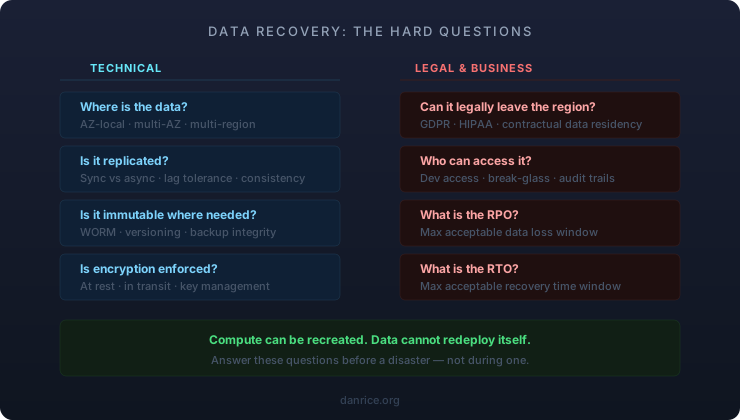
This is where cloud architecture stops being purely technical and starts intersecting with legal teams, compliance officers, auditors, and finance. The recovery conversation becomes a governance conversation.
Data Sovereignty Changes Everything
Many organizations initially treat cloud region selection as a performance or availability decision. Often it is not. Often it is a legal one.
Healthcare, finance, government, and international organizations routinely face requirements under HIPAA, GDPR, PCI-DSS, SOC 2, CJIS, regional privacy laws, contractual obligations, and internal governance controls. Architecture discussions in these environments must answer questions like:
- Can customer data leave a country or region?
- Can backups cross geopolitical boundaries?
- Are AI training datasets permitted in another region?
- Are logs accidentally capturing protected information?
- Does the disaster recovery design preserve the same compliance posture as production?
At this point, infrastructure decisions become inseparable from corporate risk management. Cloud architecture becomes policy architecture.
The Managed Platform Conversation
Eventually most organizations evaluate managed analytics, AI, and data platforms — Databricks, Snowflake, AWS-native analytics, managed Kubernetes offerings, SaaS observability, cloud-native ML platforms.
The reason is rarely that engineers cannot build the pieces themselves. The reason is that operating distributed infrastructure is itself a full-time product. Managed platforms offer operational abstraction, integrated governance, scaling automation, managed security controls, and reduced day-two burden.
But abstraction is not free.
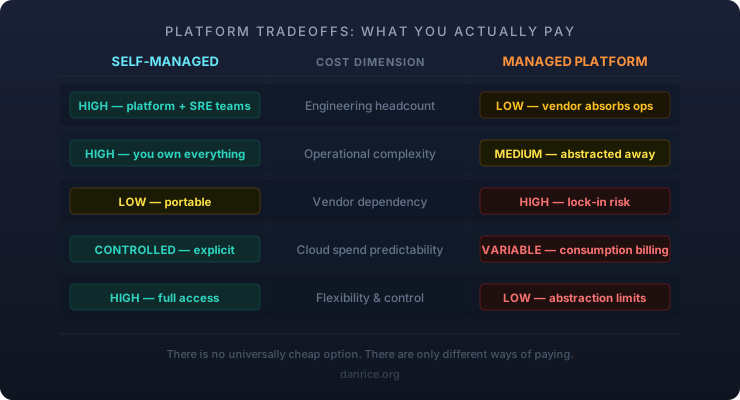
There is no universally cheap option. There are only different ways of paying:
| You pay with... | In a self-managed platform | In a managed platform |
|---|---|---|
| Engineers | High | Low |
| Operational complexity | High | Low–Medium |
| Vendor dependency | Low | High |
| Cloud spend | Controlled | Can grow fast |
| Flexibility | High | Reduced |
| Organizational risk | Spread | Concentrated |
The honest question is not which is cheaper — it is which cost structure fits your organization's risk tolerance and team capacity.
Cost Optimization Is Architecture
Cost optimization is treated as an afterthought far too often. In modern cloud environments, cost is a design signal.
Cross-AZ traffic on every request is an architecture decision. Idle GPU nodes are an architecture decision. Teams spinning up expensive managed services without guardrails is an architecture decision. A disaster recovery setup that requires a full duplicate environment running hot in another region is an architecture decision.
FinOps is not finance asking engineering to spend less. Done well, it is a feedback loop between architecture, usage, reliability, and business value. The question is not how do we make this cheaper? — it is:
"What are we paying for, why are we paying for it, and does that cost match the value and risk profile of the workload?"
What Complexity Should You Intentionally Own?
The key architectural question has shifted. It used to be: can we technically build this ourselves? Modern engineering teams can build almost anything.
The more important question is: what complexity should we intentionally own?
Every layer an organization owns becomes another operational dependency, security boundary, disaster recovery scenario, compliance concern, staffing challenge, and financial variable. The organizations that succeed long-term are not necessarily those with the most advanced technology. They are the ones that understand their operational limits, align architecture with business priorities, manage risk deliberately, and recognize where abstraction creates genuine value.
The New Reality
Cloud architecture is no longer simply about infrastructure. It is now the intersection of distributed systems, finance, compliance, security, automation, governance, and business strategy.
The engineers who become most effective in this space eventually recognize that every infrastructure decision is simultaneously a technical decision, a financial decision, a resiliency decision, a security decision, and increasingly a legal decision.
That realization is the moment infrastructure engineering evolves into platform strategy — and the moment teams realize they were never just deploying applications in the first place.